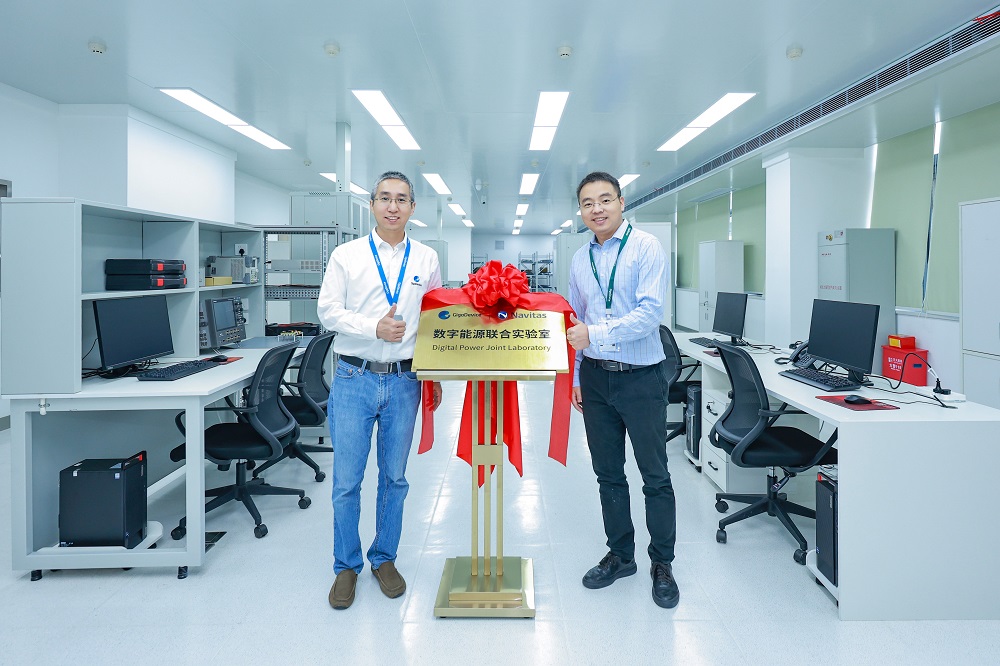
GigaDevice and Navitas Semiconductor have officially launched a Digital Power Joint Lab, a collaborative initiative designed to accelerate the deployment of intelligent power management across multiple high-growth sectors. The partnership integrates GigaDevice’s portfolio of Flash memory and 32-bit microcontrollers (MCUs) with Navitas’ high-frequency Gallium Nitride (GaN) and GeneSiC silicon carbide technologies.
The collaboration focuses on addressing the increasing demand for high-density, high-efficiency power designs in AI data centers, photovoltaic inverters, energy storage systems, and electric vehicle infrastructure. By merging GigaDevice’s GD32 MCU expertise with Navitas’ integrated GaNFast and GaNSafe technologies, the lab aims to provide comprehensive system-level reference designs for next-generation digital power systems.
Several technological milestones have already been achieved by the lab prior to its formal opening. These include the development of 4.5kW and 12kW server power supply solutions alongside a 500W single-stage PV micro-inverter.
The 500W PV micro-inverter solution utilizes the GD32G553 MCU and GaNFast Bi-Directional power ICs. This design employs a single-stage one-to-one architecture that converts DC directly to AC, removing the need for an intermediate DC-DC stage. This approach improves power density while reducing component count and system loss. Using an advanced hybrid modulation strategy and soft-switching techniques, the system achieves a peak efficiency of over 97.5% and an MPPT efficiency exceeding 99.9%.
For the data center market, the lab developed 4.5kW and 12kW power solutions targeting AI and hyperscale servers. These designs utilize the GD32G553 MCU in conjunction with Navitas GaNSafe ICs and Gen-3 Fast SiC MOSFETs. The 12kW model is designed to comply with OCP, ORv3, and CRPS standards. Through a compact, optimized layout, the solution reaches a peak efficiency of 97.8%, surpassing the 80 PLUS “Ruby” efficiency benchmark.
Moving forward, the Digital Power Joint Lab will expand its research to develop further application-specific solutions. The partnership represents a strategic effort to integrate hardware and control logic to enable smarter, more energy-efficient power systems in the fields of renewable energy and electric mobility.