
VersaLogic Expands Rugged Connectivity with Industrial-Grade M.2 Modules

A new series of expansion cards brings reliable Ethernet, Serial, and CAN Bus capabilities to embedded systems operating in extreme environments. By Embedded Systems Engineering / 05 Nov 2025
Follow ESE

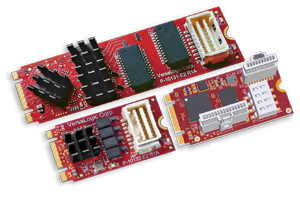
VersaLogic Corp has introduced a new line of rugged M.2 modules engineered to provide reliable connectivity for embedded systems operating under harsh conditions. The expansion series is designed specifically for original equipment manufacturers (OEMs) and system integrators who require high-performance peripheral support within extremely small form factors.

The new lineup includes four distinct module options to address various interface requirements. These consist of a single-port Gigabit Ethernet module with onboard magnetics, a dual-port Gigabit Ethernet version, a dual-port Serial and GPIO module, and a dual CAN Bus module. To ensure reliability in demanding sectors such as defense, transportation, and industrial automation, the modules are rated for full operation across the industrial temperature range of -40° to +85°C.

In addition to thermal resilience, the modules are built to withstand physical stress, meeting MIL-STD-202H standards for shock and vibration. The compact boards utilize different M.2 keys and lengths, including 2242 and 2280 form factors, allowing for flexible integration into modern embedded architectures where space is at a premium.

“Customers can now easily add more connectivity features to embedded systems with reliable, full-performance M.2 modules designed for industrial temperature applications (-40° to +85°C),” said Len Crane, VersaLogic President. “These compact M.2 expansion boards prioritize thermal management and operate flawlessly across the entire industrial temperature range.”

VersaLogic focuses on providing industrial connectivity and embedded computing solutions that maintain high performance even when exposed to environmental extremes. These latest additions to their catalog aim to simplify the process of scaling system capabilities without compromising the ruggedness of the overall hardware deployment.

Posted by Embedded Systems Engineering Connect

Latest Articles

ThunderSoft Debuts AI-Native Operating System Architecture Across Automotive and Robotics Sectors

New AIOS platform integrates system-level artificial intelligence to bridge the gap between digital models and physical hardware execution.

Jan 12, 2026
Modular Development Kit Streamlines Zone Controller Design for Software-Defined Vehicles

Infineon and Flex debut a scalable ZCU platform featuring 30 unique building blocks to accelerate automotive E/E architecture transitions.

Jan 07, 2026
TDK Advances Wearable Intelligence with Edge-Processing Motion Sensors

New SmartMotion IMUs offload computational tasks from the central processor to the sensor, enabling high-fidelity spatial audio and AR overlays with ultra-low power consumption.

Jan 07, 2026
NXP Launches S32N7 Processor Series to Centralize Core Vehicle Functions

New 5 nm super-integration processors enable OEMs to consolidate propulsion, safety, and body domains into a single hub, reducing architecture complexity and costs.

Jan 05, 2026
High-Endurance NVMe BGA SSDs Gain Traction in Mission-Critical Programs

Greenliant’s NVMe NANDrive EX Series targets aerospace and industrial applications with ultra-high endurance and advanced security features.

Jan 04, 2026
High-Performance Edge Platform Debuts to Accelerate AI-Driven Clinical Diagnostics

Axiomtek introduces a medical-grade computing system featuring 13th Gen Intel Core processing and dedicated GPU expansion for real-time imaging and surgical monitoring.

Jan 04, 2026

Featured Content

Voyant Photonics Unveils Fully Solid-State 4D FMCW LiDAR Platform

The new Helium family leverages silicon photonics to provide high-resolution depth and velocity sensing in an ultra-compact, software-defined package for autonomous systems.

Dec 18, 2025