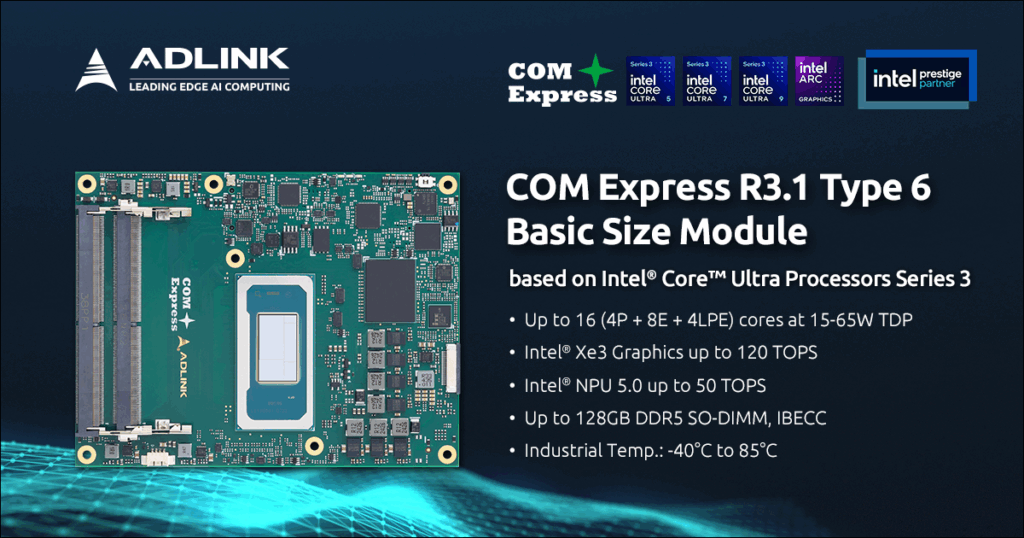
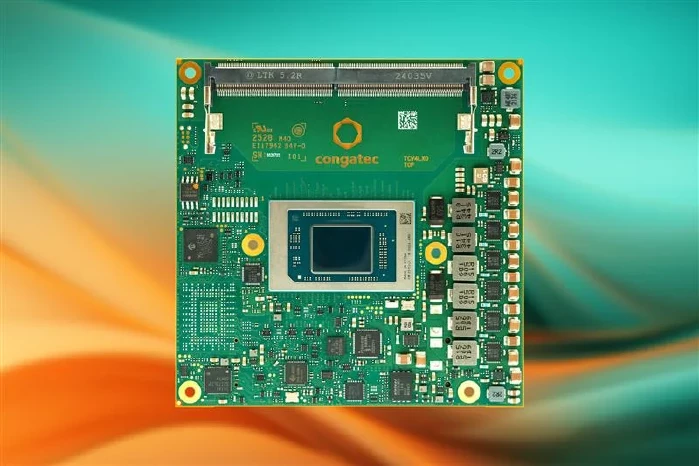
congatec has expanded its x86 Computer-on-Module portfolio with the launch of the conga-TCRP1, a new COM Express 3.1 Type 6 Compact series. Based on the latest AMD Ryzen AI Embedded P100 Series processors, these modules are engineered to support industrial temperature ranges from -40 to +85 °C. The series aims to provide an efficient entry point for industrial edge AI applications, targeting sectors such as transportation, medical technology, smart city infrastructure, robotics, and industrial automation.
The modules deliver a combined AI inference performance of up to 59 TOPS. This total is achieved through a combination of the XDNA2 NPU, which provides up to 50 TOPS, and the remaining performance contributed by up to six AMD Zen5 CPU cores and the RDNA3.5 GPU. This hardware configuration allows for the local real-time processing of smaller large language models (LLMs) without requiring cloud connectivity or discrete accelerators.
The conga-TCRP1 is designed for scalability and power efficiency, featuring a configurable thermal design power (TDP) ranging from 15 to 54 W. The 15 W minimum TDP enables the development of completely enclosed, passively cooled designs, which are essential for rugged handhelds and hygienic medical PCs used in harsh environments.
“With the increasing demand for rugged edge applications with or without AI, there is also a growing need for entry-level COM variants with 4 and 6 cores for power- and cost-optimized designs. The conga-TCRP1 expands congatec’s comprehensive portfolio for precisely these application areas, targeting cost-sensitive designs that require optimal performance per watt,” said Florian Drittenthaler, Product Line Manager at congatec.
The architecture utilizes a combination of performance-oriented Zen5 cores and energy-efficient Zen5c cores. Because both core types share the same architecture, they ensure consistent execution timing, which is a critical requirement for deterministic real-time applications. For graphics, the integrated Radeon RDNA 3.5 GPU supports up to four independent 4k display connections.
Technical specifications include support for up to 96 GB of DDR5-5600 RAM with optional Error Correction Code (ECC) for mission-critical reliability. For connectivity and expansion, the modules offer up to eight configurable PCIe Gen4 lanes, PEG x4 Gen4, and 2.5 GbE networking. Peripheral support includes four USB 3.2 Gen2 ports, four USB 2.0 ports, and dual SATA 6Gb/s interfaces, alongside an optional onboard NVMe SSD of up to 512 MB.
The modules support a variety of operating systems, including Microsoft Windows 11, Windows 11 IoT Enterprise, Linux, ctrlX OS, Ubuntu Pro, and Kontron OS. Through the aReady.VT option, an integrated hypervisor-on-module allows developers to consolidate workloads such as real-time control, HMI, and AI onto a single unit. To assist in the development process, congatec provides a supporting ecosystem of evaluation carrier boards, cooling solutions, and design-in services.