
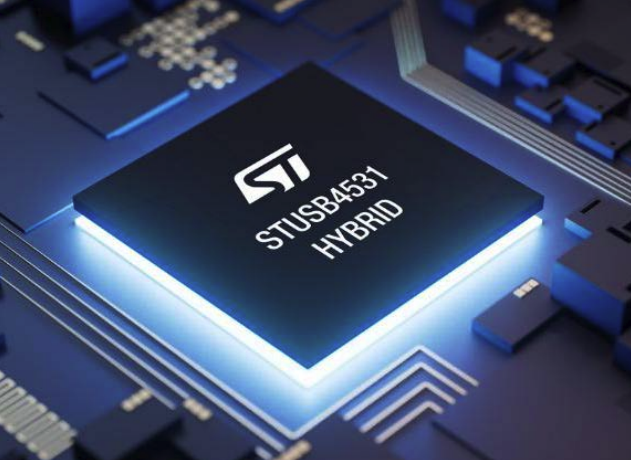
STMicroelectronics has launched the STUSB4531 USB Power Delivery (PD) sink controller, featuring a patented hybrid mode designed to simplify the implementation of advanced USB PD features in powered and chargeable devices. The controller aims to reduce the complexity of integrating high-value functions into electronics such as portable audio equipment, wearables, healthcare devices, and industrial tools.
The device integrates a certified, hardwired USB PD stack alongside proprietary AUTORUN algorithms. These algorithms facilitate software-free power negotiation, supervision, and management, allowing for efficient power profile negotiation with AC adapters. The updated logic supports adjustable voltage supply (AVS) and high-power charging in dead-battery mode to enable faster device reactivation.
A key development in the STUSB4531 is the new hybrid mode, which allows an external application processor to interact with the internal stack. This architecture enables engineers to leverage protocol layers for USB PD communication while maintaining the flexibility to implement custom functions. These include battery messaging, data role swapping, Alternate modes, and vendor-defined messages (VDM), significantly accelerating time to market by easing the software development burden.
The controller’s capabilities are suited for a variety of use cases. Applications involving charging with USB data transfer include hard disk drives, point-of-sale (POS) terminals, and drones. Furthermore, devices such as VR headsets, portable displays, and infotainment systems can utilize the controller to combine USB power with Alternate modes for DisplayPort or Thunderbolt protocols.
The STUSB4531 is certified according to the latest USB-C 2.4 and USB PD 3.2 standards, as well as IEC 62680 for EU conformity. This alignment supports the global transition to USB-C charging standards mandated by ecodesign regulations to reduce electronic waste.
To support development, the controller is backed by an ecosystem including evaluation boards, reference designs, and a graphical user interface. An open-source software library is also expected to be available shortly. The IC is currently in production and is offered in both QFN16 and chip-scale CSP16 packages.