
TDK Corporation has introduced a new suite of InvenSense SmartMotion custom sensing solutions designed to enhance user experiences in TWS earbuds, AI glasses, smartwatches, and fitness bands. These latest inertial measurement units (IMUs) are built upon the ultra-low power ICM-456xx family, featuring on-chip sensor fusion and machine learning capabilities that allow for edge intelligence directly within the hardware.
By performing motion tracking and detection algorithms locally on the sensor, these devices offload the heavy computational requirements typically handled by a System-on-Chip (SoC) or microcontroller. This architecture results in lower system latency and reduced power consumption, as other system components can remain in low-power modes while the sensor makes intelligent decisions.
“The challenge in today’s wearable market is delivering features like seamless augmented reality (AR) or high-fidelity spatial audio without sacrificing the compact, stylish form factor and all-day battery life,” said Pankaj Aggarwal, VP & GM of the Consumer and Industrial Motion, InvenSense, a TDK group company. “Our ICM-456xx family with BalancedGyro™ technology and on-chip intelligence solves this problem. It ensures that every user head turn, every UI gesture, and every AR overlay is instantaneous, stable, and incredibly power efficient.”
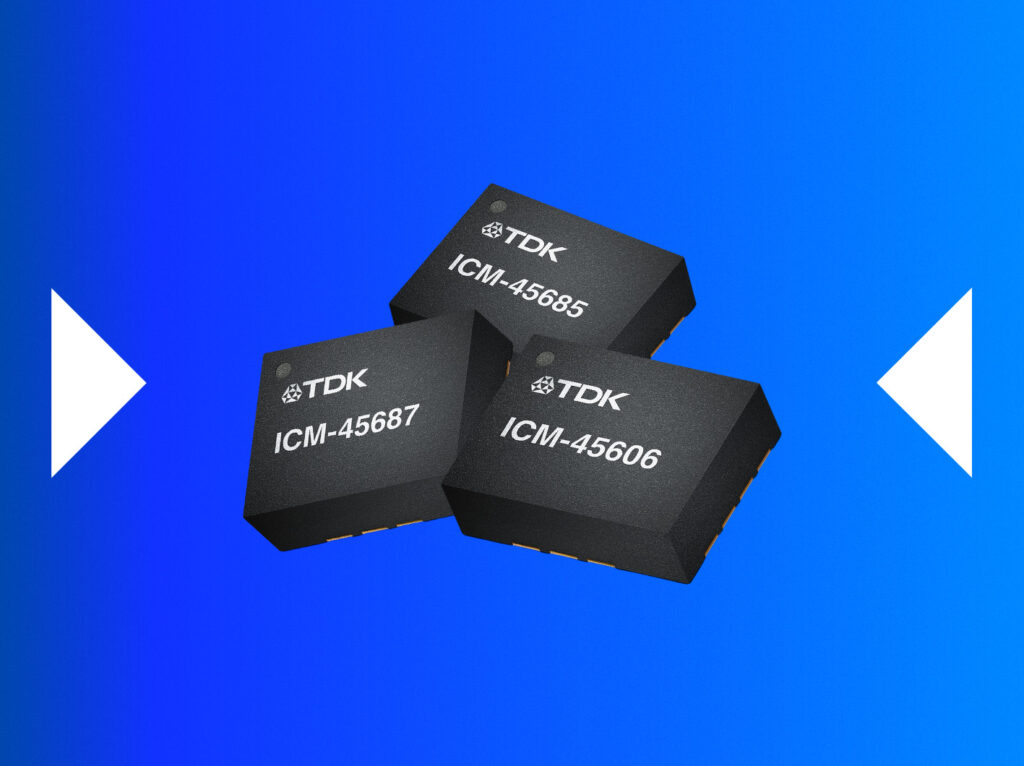
The expanded lineup includes three specialized solutions:
The SmartMotion ICM-45606 is tailored for TWS applications. It supports high yaw accuracy for spatial audio, vocal vibration detection, and machine learning for gesture and activity sensing. This component is expected to be available through distributors by the end of the first quarter.
For general wearable and IoT technology, the SmartMotion ICM-45687 provides on-chip algorithms for functions such as bring-to-see, wake-on-motion, and tap detection, alongside activity classification.
The SmartMotion ICM-45685 is optimized for smart glasses, featuring wear detection to determine when a user puts on or removes the eyewear. It also utilizes vocal vibration detection to identify speech sources. This solution supports high-precision head orientation tracking, image stabilization, and posture recognition at ultra-low power levels.
In addition to the IMUs, TDK’s broader ecosystem for smart glasses includes TMR sensors for hinge angle detection, MEMS microphones for voice-activated AI, and ultrasonic time-of-flight sensors for gesture tracking. The PositionSense 9-axis solution further integrates IMU and TMR magnetometer data for absolute orientation and navigation.